Meeting UK Working-at-Height Requirements & BS EN 13374:2025
Working at height remains one of the highest-risk activities on UK construction sites. When using Liftroller equipment, contractors must ensure that openings created for material handling are protected in line with UK regulations and the European standard BS EN 13374 for temporary edge protection systems.
Liftroller systems are designed to support safe, compliant material loading on live construction sites. Below is a clear breakdown of how each model meets the required standards.
Liftroller Wall (Window System)
Built-in edge protection – no separate gate required
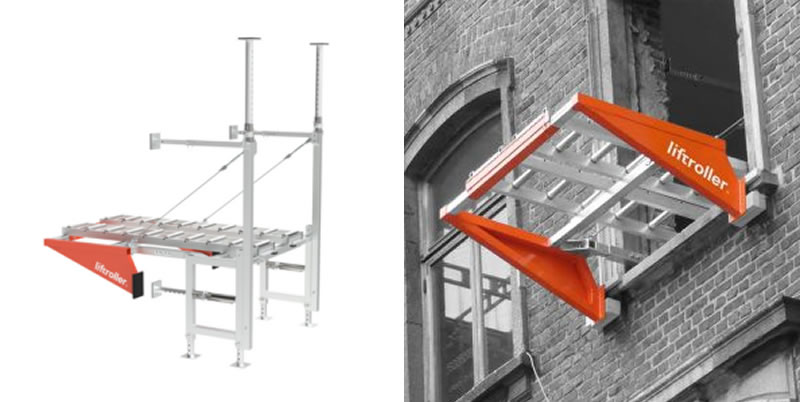
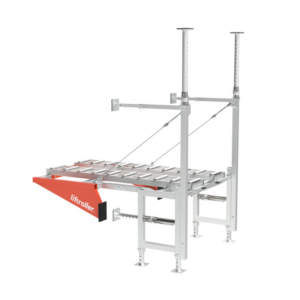
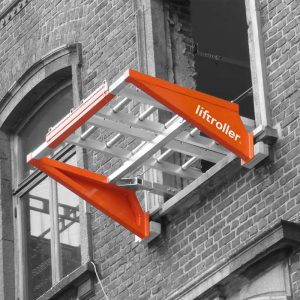
The Liftroller Wall does not use a gate. Instead, the roller platform itself forms a permanent, physical barrier across the window opening during all loading operations.
How it meets BS EN 13374
- Guardrail-equivalent height
The roller bed sits between 930 mm (lowest leg setting) and approximately 1200 mm (highest setting).
This places the barrier within the guardrail height requirements of BS EN 13374 Class A, providing continuous edge protection. - Operator always stands behind the barrier
All loading/unloading is performed from inside the building. Workers never need to lean out or work in front of the opening. - Continuous leading-edge protection
Because the window opening remains blocked by the roller platform throughout the operation, a separate gate or removable edge protection is not required. - Industry-recognised compliance
The Liftroller Wall setup has undergone successful Health & Safety reviews with major international contractors including Bouygues, Vinci, Skanska, and BAM, specifically in relation to working-at-height protection and EN 13374 compliance.
Liftroller Floor (Floor Openings)
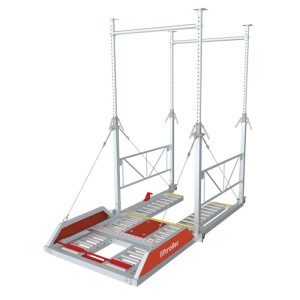
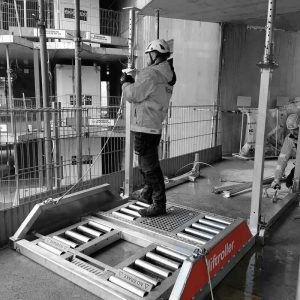
Floor openings create a potential fall hazard, meaning temporary edge protection is required under UK regulations. The relevant standard is BS EN 13374 Class A, which specifies guardrails, intermediate rails and toe boards.
Standard configuration – supplied with EN-compliant safety barrier
The Liftroller Floor is delivered with a purpose-designed Edge Protection Barrier meeting EN 13374 Class A.
When fitted, this provides full collective protection around the opening.
Two barrier positions
The barrier can be mounted in two compliant positions:
- Front position – when materials are being rolled in/out
- Rear position – when loading is complete but the unit remains in place
The barrier must remain installed for the full hire period. EN 13374 only permits temporary removal for a specific task, and it must be replaced immediately afterward. Removing edge protection entirely is treated the same as removing a guardrail from scaffolding — the site would no longer be compliant.
Using Liftroller Floor During Loading
When the Edge Protection Barrier is removed
During loading, the barrier must be taken off to allow materials to pass through the opening.
At this point:
- The operator is exposed to a fall risk
- Personal fall-protection equipment (PPE) is required (typically a fall-prevention harness), in accordance with site Working-at-Height procedures
- This is the standard practice on UK sites using the current Liftroller Floor model
Summary: Compliance at a Glance
| Product | Built-In Protection | EN 13374 Compliance | Additional Requirements | Notes |
| Liftroller Wall | Yes – roller platform forms barrier | Class A – compliant height & leading-edge protection | None, provided operators do not climb on the unit | No gate required |
| Liftroller Floor | Yes – supplied Edge Protection Barrier | Class A | PPE required when barrier temporarily removed for loading | Barrier must remain installed |
Speak With Our Team
Want to learn how Liftroller can improve efficiency and safety on your project?
Contact us today:
📧 Email: jane@liftrolleruk.com
📞 Phone: 0370 741 7600